Winter Wanderings

Blackfoot Valley Trumpeter Swans may have left our watershed for the winter, but that doesn’t mean they have been entirely out of sight.  We’ve received notice of some great observations of “our” swans in more southern locations since we last saw them in the Blackfoot.

In late November, an observer in Idaho reported seeing Swan 5A9 at a pond along a road near Challis, Idaho (approximately 185 miles south of where she was released in 2011 and spent the summer of 2012, near Ovando).

Three weeks later, on November 19, 5A9 was sighted in a flooded field just south of Rexburg ID (about 125 miles southeast of where she had been sighted near Challis).  And we received yet another sighting of 5A9, on December 30, on the Henry’s Fork of the Snake River just several miles north of Rexburg.  We haven’t had any reports of 5A9 since.  Did she settle down in the Rexburg/St. Anthony’s area for the winter?  Or did she continue her wanderings in search of a favorite winter home?  At the very least, we hope to see 5A9 again this spring on a local wetland.

Go to the Adopt-A-Swan home page at http://www.blackfootchallenge.org/SwanProject/home to see a map of 5A9′s travels and other recent swan locations!

Swan 5A9 near Challis, ID on 10/31/2012

Other winter sightings include one of our Blackfoot swan families and others in the Ruby River valley near Sheridan, Montana on January 22.  In a group of 20 swans (15 adults and 5 cygnets) were 0A6, (who was released in 2010 and paired with 0A5 in 2012) and 3P6 (one of the nesting pair that successfully raised cygnets the past 2 years).    Also in the group were 3 swans with small metal leg bands only; these were likely Blackfoot birds that had lost their red collars and leg bands, and may have included the mates of 0A6 and 3P6.
At least some of the cygnets were probably from the nests in the Blackfoot in 2012 (the cygnets aren’t marked in any way, so we can’t be 100% sure of their identity once they begin to fly, but the fact that they were with at least one of the nesting adults is a good clue).

Blackfoot Trumpeters and others in the Ruby Valley

Blackfoot Trumpeters and others in the Ruby Valley

Swans 2A3, 2A5, 2A6, and 7A5 (all released in the Blackfoot last summer) were also seen near Sheridan for most of the month of February.  This area has some warm springs that maintain open water in some of the ponds and wetlands along the river even when they would otherwise be iced over.

Finally, we had one sighting of a swan with a red leg band on Hebgen Reservoir near West Yellowstone on February 11.  This was interesting because the band was spotted from an airplane by a pilot doing a survey!  Can you see the red and white band in the photo below that he took?  You can click on the photo to enlarge it.

Swans at Hebgen

Swans at Hebgen Reservoir

If you look very carefully at the photo, you may be able to see the red and white band on the swan on the far right.

I expect to begin seeing or hearing about swans back in the Blackfoot any day now.  Last year our first spring sighting of returning Blackfoot Trumpeters was on March 4.  So if you are in the Blackfoot, please look carefully at open water on ponds and wet fields as you go by them or work near them; you may see our first big white “snowbirds” returning home!

Trumpeters and Tundras

The passing fall has seen some swans leave the Blackfoot and others arrive.  However, unlike during the summer months, not all the swans we are seeing lately are Trumpeter Swans.  This time of year, Tundra Swans are migrating through western Montana from their breeding grounds in the far north.  As its name implies, this species breeds on the high tundra across the northern edge of North America.

Trumpeters and Tundras are very similar in appearance and can be quite challenging to positively identify.   (Snow Geese are also relatively large, mostly white water birds, although they are less than half the size of Trumpeters.   Snow Geese have black wingtips.)  Here are some tips for telling Trumpeters from Tundras:

The Trumpeter Swan is larger than the Tundra, although they usually have to be seen together to be able to distinguish them by size.  The Trumpeters also has a larger, straighter bill relative to the head and the head may appear longer and less rounded than in the Tundra.  The black of the bill extends around the eye, so that the eye is not distinct from bill.  The bill is black and often has an orange line on the lower mandible; orange may be present on some Tundras.  The neck of the Trumpeter appears longer than the Tundra’s neck.

On the Tundra Swan the bill is more dish-shaped in profile, and smaller in proportion to the head compared to Trumpeter.   The head is very round and the eye is usually distinct from the bill. Tundra Swans have a wide range of head-bill shapes, some having very obvious concave bills, while others appear straighter.  Most have a yellow spot of varying size in front of the eye.

Since a picture may be worth a thousand words, here are a couple to compare:

Trumpeter Swan

Tundra Swan

(If you really want to pursue this further, check out David Sibley’s post on distinguishing the two species at http://www.sibleyguides.com/2006/02/distinguishing-trumpeter-and-tundra-swans/ .)

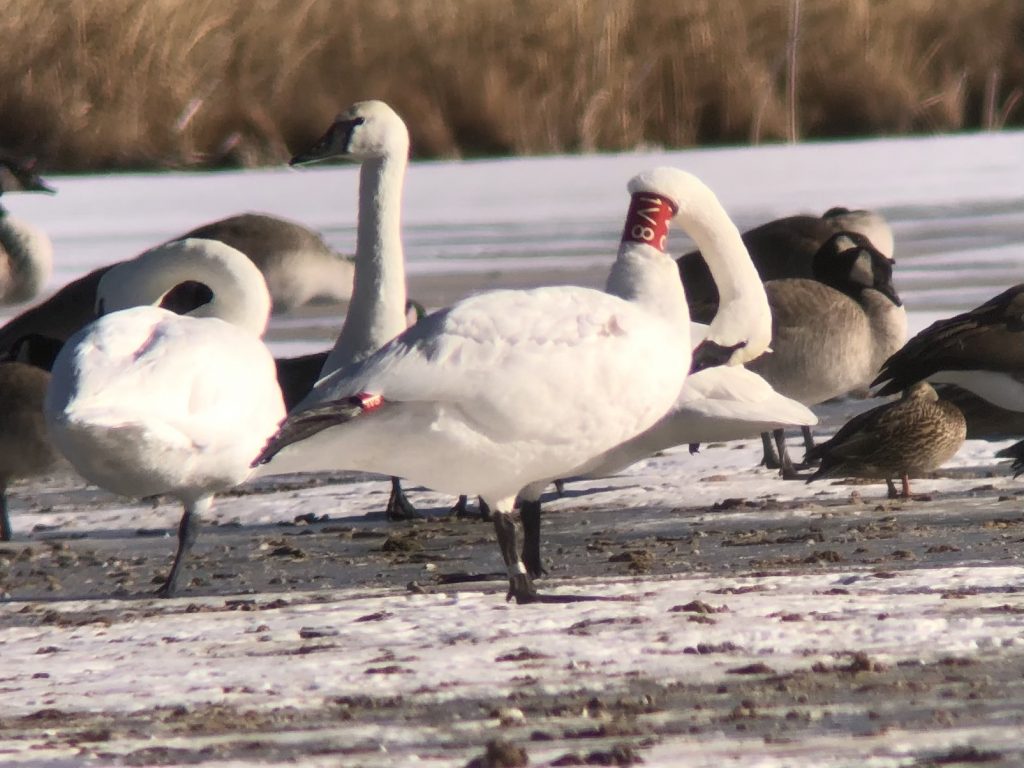
I have been seeing flocks of Tundra Swans on some Blackfoot lakes and ponds, I’ve been seeing some migrating Trumpeter Swans who are passing through from the north, and I’ve been seeing some of our Blackfoot Trumpeters that haven’t left the valley yet.  Often I will come upon a group that is a combination of all of these, and I have to look carefully for quite a while to be sure how many there are of each.  Because several of our Blackfoot birds have lost their neck collars, spotting their leg bands may be the only way to tell if they are resident Trumpeters.  However, if I see a large number of swans with no collars, it is likely to be a flock of migrating Tundras.

Trumpeters and Tundras mixing it up on a local wetland

Thanks to everyone who has sent sightings and swan photos to me recently!  It’s always helpful to get the updates.

Cygnets Take to the Air

Another milestone came in the Blackfoot Trumpeter Swan Reintroduction Program this month, as the cygnets hatched last spring began to fly.

A pair of swans that nested in the Ovando-Helmville area hatched out an amazing 6 eggs this year.  One cygnet disappeared shortly after hatching, but the remaining 5 survived into October.  The family began to be sighted at various wetlands in the area by local human residents in early October.  However, only 4 of the cygnets have been seen with their parents since leaving the wetland where they were hatched.  At this point we don’t know if the fifth cygnet is still alive and just not flying yet, became separated from the rest of its family somehow, or has died.

A pair that nested northwest of Ovando has 2 cygnets, and this family has been seen visiting new wetlands in the area as well.  Having at least 6 more cygnets reach the point of flying is an important boost to our local swan population.

The groups of young swans released last spring and summer have scattered into the valley now that they can fly, some joining up with older pairs to explore new wetlands.  With the first real snowfall of the season, the large white birds have become a little harder to spot!


Remember, you can see an interactive map of where Blackfoot swans have been most recently sighted at the Adopt-A-Swan website and follow the movements of individual swans there as well.

Thanks very much to everyone who has reported their sightings!

Swans on the move

During the summer months, Trumpeter Swans in the Blackfoot were pretty stationary.  Newly released young swans have had the feathers on their wings clipped, so that they stay near their release point for a couple of months after release.  This increases the chances that they will become attached to the area and return the following years, eventually establishing a territory and breeding.   They molt and grow new feathers over the summer, so they are able to start flying in late summer.  Like most waterfowl, adult swans that have returned to the Blackfoot lose the ability to fly for a few weeks when they molt in mid-summer.  A pair of swans will generally return to the wetland where they molted to breed in future years.

So during the middle of the summer the Blackfoot swans were pretty easy to keep track of.  Occasionally some of them would take a “walkabout” to a nearby wetland, which could be a potentially dangerous journey exposing them to predators.  But this year all the young swans stayed close to their new homes and survived any short terrestrial journeys they did make.  On my summer rounds to check on them, I was always relieved when I found them safe and sound where I had last seen them!

Now, however, they have all learned to fly and most of the 15 young birds released this spring have moved off their release sites.  Tracking them down can be both fun and challenging.  Some days I am able to find many of them simply by driving to some local lakes and wetlands, but lately I’ve been spending more time hiking around to look for them.  After checking on a map or Google Earth for wetlands tucked away in the valley, I head out across the prairie or through the woods.  It’s always a thrill to tromp through the sagebrush and bunchgrass and come over a hill to see swans in a pond below me.  I quickly set up my spotting scope and read the codes on their red collars.  While they usually see me and watch alertly, I stay far enough away so that they don’t try to fly off.  Often they will resume feeding or preening after a few minutes of watching me, apparently deciding I’m not too dangerous.  They must recognize me after seeing me every week, even though I don’t wear a large identifying collar!

How many swans can you find in the above photo? (Hint: check out the closeup view through the spotting scope in the photo below. Count necks, not bodies!) There are 3 swans on the left side of the photo above and 3 on the right.