
By Elaine Caton, Trumpeter Swan Restoration Program Coordinator
In spite of a worldwide pandemic and all the associated changes to human life that have gone with it, I’m happy to report that our Trumpeter Swans have kept calm and carried on with normal swan life in the Blackfoot. Although we only had six pairs of swans attempt to nest this year (following eight attempts in 2019), five of those nests were successful, hatching a total of 20 cygnets. And all 20 cygnets survived to fledging (flying) age! 100% fledging success is a new record for us, and 20 cygnets is a healthy number.
Young swans released
We released three yearling swans in June. Yearlings we release have their flight feathers clipped short so that they can’t fly immediately. This gives them a chance to become bonded to the area where they are released. In mid-summer, all swans molt out all of their flight feathers and grow new ones, leaving them unable to fly for a few weeks. When the new feathers grow in, the yearlings we release are able to fly like the other swans.
GPS collars and locations
We also put GPS radio collars on two adult (non-nesting) swans in the watershed. We were able to do this relatively easily during the swans’ flightless period in summer. At that time a few people in kayaks can paddle after a swan and corral it as it tires from swimming and lift it into a kayak. It’s a safe and relatively low-stress way to capture a huge bird! (Watch a video of it here!) The collars are extremely lightweight and we’ve seen no evidence that they hinder the swans. We check on those swans in the days after collaring to make sure there are no adverse effects.
Although we get a lot of helpful information from sightings of swans that we make and that local observers send to us, being able to track the daily locations of some birds adds a tremendous amount to our understanding of how swans use the landscape. We have learned that they use wetlands we didn’t know about or can’t get to easily, and that they move around a lot during the summer. This helps us know which areas and kinds of wetlands provide the best habitat for swans, and can allow us to prioritize things like marking powerlines in places that they frequent.
Swan movements in the Blackfoot
This map shows the locations and movements of one swan that we collared in July, from the time we put the collar on until it flew south out of the Blackfoot in October. Some of the blue squares represent multiple days in one location. We only actually saw and identified this swan by its collar four times during the summer, but we now know where it spent every day. This will also help us know where to concentrate our efforts to look for other swans, and get more accurate counts of their population numbers.

Swan #10 left the Blackfoot on October 26, the weekend of our early winter storm, and flew approximately 126 miles to Alder, MT. The Ruby River valley around Sheridan and Alder is where many of the Blackfoot swans winter, and #10 has been in that area ever since.

There are several folks in the Sheridan area who keep an eye out for collars and leg bands on the many swans that winter there. A yearling swan (1V8) that we released this June was observed near Sheridan, MT on 12/4. This photo was sent in an email from the owner of Ranch Resources, a conservation ranching company in Sheridan, who spotted 1V8 on a pond just outside of town, along with 20 other swans.
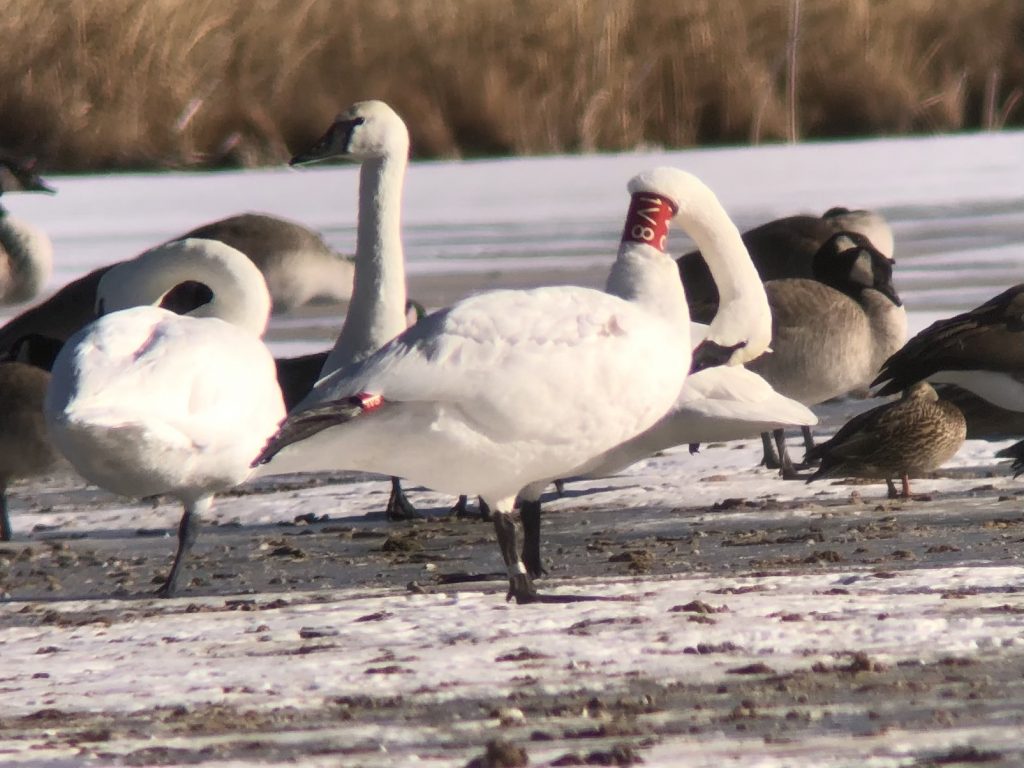
Another yearling that we released, 1V2, was also spotted near Sheridan on 12/22, very close to where Swan #10 is.
Our second GPS-collared swan left the Blackfoot on 11/14. She flew to Ennis Lake and spent two and a half weeks there, and on 12/1 flew to the Henry’s Fork of the Snake River, near Island Park in southeast Idaho, and she is still there.
Interested in supporting Trumpeter Swan recovery in the Blackfoot? Donate here.